
How Far Ahead Should Employers Arrange Accommodation for Temporary London Assignments?
Updated: 3 days ago
By Sisi Stay
Employers should begin arranging accommodation as soon as the assignment dates, work location and budget are reasonably clear. For a straightforward placement, starting several weeks ahead gives more time to compare suitable options and resolve paperwork. Longer assignments, larger teams, peak-demand dates or specific requirements justify starting earlier.
There is no responsible universal deadline that guarantees a property will be available in London. If the assignment has been confirmed at short notice, contact accommodation providers immediately and be ready to discuss alternative dates, locations, property types or facilities.
In short: begin the search when the assignment is approved, not when the employee is due to arrive. The more people, restrictions and fixed dates involved, the earlier accommodation should be arranged.
What determines how far ahead to book?
Lead time is mainly a risk decision. An employer with one employee, flexible dates and limited requirements may have more options than a business moving a project team to London with fixed start dates and strict invoicing requirements.
Before deciding when to make enquiries, consider the following factors.
Assignment length
A short stay can sometimes be arranged with less notice, but that does not mean leaving it until the last minute is sensible. A late search may reduce the available choice or make it harder to find accommodation that works for the full period.
For a longer temporary business stay, it is worth starting earlier because the accommodation needs to work beyond the first few nights. The employer may need to check practical matters such as storage, cooking facilities, cleaning arrangements, parking, transport links and whether extensions are possible.
Number of employees
Accommodation for one person is a different planning problem from accommodation for a team. If several employees need to arrive around the same time, the employer may want properties close together or a consistent arrangement for everyone.
That can narrow the available options. Give the provider an accurate headcount, the expected arrival pattern and whether employees need individual rooms or shared accommodation before comparing proposals.
Fixed dates and work location
Accommodation becomes harder to arrange when arrival and departure dates cannot move. The same applies when employees must be close to a particular worksite, transport route or meeting location.
London is a large area, so “in London” is not enough information for a useful search. An employer should provide the relevant work location or area, expected travel requirements and any restrictions on commuting. A slightly wider search may create more choice, but only if the journey remains practical for the employee.
Specific requirements
Requirements such as step-free access, a separate bedroom, parking, cooking facilities, a desk, pet acceptance or proximity to a particular transport route should be raised at the start. Do not assume that a property described as suitable for business stays will automatically meet every individual requirement.
Some requirements can be checked quickly; others may need confirmation from the accommodation provider. The earlier they are identified, the less likely the employer is to make a decision based on incomplete information.
Internal approval and payment arrangements
The accommodation search is only one part of the process. Many employers also need approval from a manager, procurement team or finance department before confirming a booking.
Ask in advance:
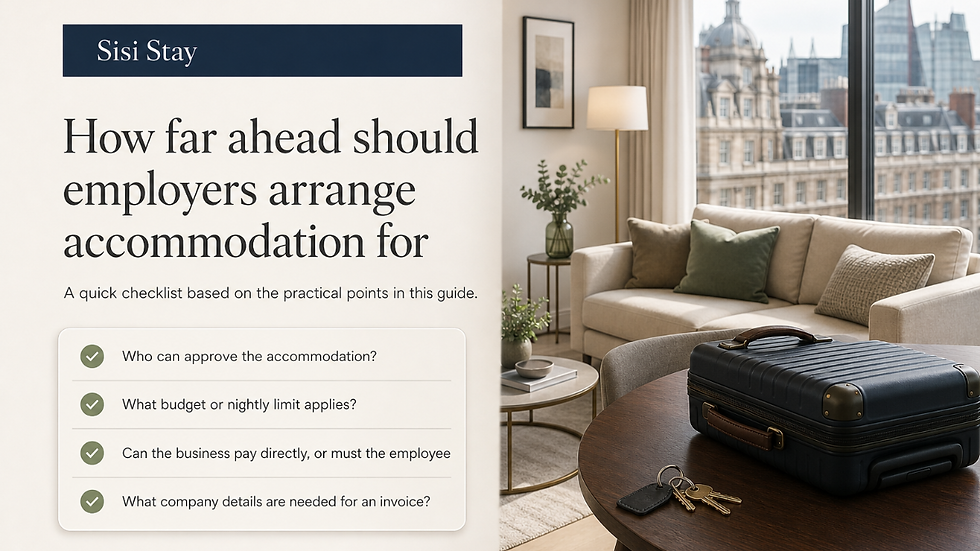
Who can approve the accommodation?
What budget or nightly limit applies?
Can the business pay directly, or must the employee claim expenses?
What company details are needed for an invoice?
Who can approve a change if the assignment is extended?
These questions do not determine whether accommodation is available, but they can affect how quickly a suitable option can be confirmed once one is found.
A practical planning guide for employers
Rather than relying on one fixed booking deadline, match the planning approach to the certainty and complexity of the assignment.
When the assignment is still being discussed
You may not be ready to confirm accommodation, but it is still useful to establish the likely area, dates, headcount and budget. This gives the business a realistic view of the options before travel or project commitments become fixed.
If the dates are only provisional, be clear about that when making enquiries. A provider may need different information before discussing availability, pricing or cancellation terms.
Once dates and the work location are confirmed
This is the point at which employers should actively arrange accommodation. Starting several weeks ahead is a sensible planning position for many ordinary assignments, although it is not a guarantee of availability or a standard required by every provider.
At this stage, prepare one concise brief containing:
Arrival and departure dates
Number of employees and room requirements
Work location and acceptable travel area
Budget or approval limit
Essential facilities and restrictions
Billing, invoice and booking contact details
Whether the stay may be extended
A clear brief reduces avoidable follow-up questions and helps the employer compare like with like. It also makes it easier to identify which requirements are essential and which are preferences.
When the assignment is approaching
If accommodation has not yet been arranged and the arrival date is getting close, the employer should make enquiries immediately rather than waiting for every detail to be perfect. State which information is confirmed and which points remain flexible.
Useful flexibility may include considering more than one London area, accepting different property layouts, changing the arrival date where the project allows it, or arranging a short initial stay while longer-term accommodation is checked. Any change should still be assessed against the employee’s travel needs and the company’s duty of care.
When the request is urgent
Urgent accommodation requests should be treated as a live availability question, not as a normal advance booking. Contact the relevant provider with the exact arrival date, number of occupants, expected length of stay and any non-negotiable requirements.
Do not assume that a same-day or short-notice enquiry will produce the same choice available to someone planning ahead. The sensible approach is to establish what can be considered now, what information is needed to confirm it and which requirements may need to be prioritised.
For an urgent London requirement, employers can review the published emergency temporary accommodation information for London Bridge and contact the business to ask whether the listed temporary accommodation service suits the assignment.
If this is the stage you are working through, you can also use When Should Businesses Review Accommodation During a Temporary London Assignment for the next practical checks.
What should employers check before confirming?
Speed matters, but a quick booking that does not work for the employee can create extra cost and disruption. Before confirming, check the arrangement against the actual assignment rather than relying only on a headline property description.
Location and daily travel
Check the expected journey to the worksite at the times the employee will actually travel. A property that looks close on a map may not be convenient if the route involves several changes or does not suit early starts and late finishes.
Where the worksite may change, explain that before booking. The right accommodation decision may be different for a single fixed site than for a project involving several locations.
Occupancy and suitability
Confirm who will stay, whether the arrangement is for one person or several, and whether employees need separate rooms. Ask about the facilities that genuinely affect the assignment, rather than treating every available feature as essential.
For example, a kitchen may matter for a longer stay, while a desk or reliable working space may matter to an employee who must complete administrative work outside site hours. These are questions to confirm, not assumptions to make from a broad service label.
Dates, extensions and changes
Ask what happens if the project ends earlier, runs longer or the employee’s start date changes. The answer may depend on the booking terms and the provider’s availability at the time of the change.
It is also worth identifying who is authorised to request an extension. An employee should know who to contact rather than assuming that an extension can be made automatically.
Payment and documentation
Confirm the total booking terms, payment method, invoice requirements and any deposit or cancellation conditions before approval. Do not make assumptions about what is included in the quoted accommodation arrangement.
Where several employees are involved, decide whether the company wants one central billing arrangement or separate records for each occupant. This is an internal control decision, but it should be settled before booking where possible.
For further planning questions, employers can refer to What Employers Should Check Before Choosing Corporate Accommodation for Temporary London Staff.
Common mistakes that create avoidable pressure
Waiting for every detail before making any enquiry
It is sensible to confirm important facts, but waiting until every project detail is final can leave little time to assess accommodation. Start by separating confirmed information from assumptions and ask what can be explored on that basis.
Giving only the arrival date
An arrival date without a departure date, headcount or work location is rarely enough to make a useful comparison. Even an estimated stay length is more helpful than leaving the provider to guess.
Choosing on price alone
The lowest headline cost may not represent the lowest practical cost if the employee faces a difficult commute, unsuitable facilities or a change of accommodation during the assignment. Compare the full arrangement against the work requirements and the cost of disruption.
Assuming hotel accommodation is the only option
Hotels may suit very short stays or employees who need limited facilities. For a temporary work assignment, company or contractor accommodation may be worth comparing where the employee needs a more settled arrangement, although the right choice depends on dates, requirements and confirmed availability.
When should you contact an accommodation provider?
Contact a provider as soon as the assignment is sufficiently defined for someone to assess it: normally when the dates, work area, occupants and essential requirements are known. Earlier contact is particularly sensible when the dates are fixed, several employees are involved or the accommodation must meet specific requirements.
Sisi Stay lists corporate accommodation, contractor accommodation and temporary business stays in London. Individual property availability and facilities require confirmation, so employers should provide the full brief and ask whether the available option suits the particular assignment.
For a broader comparison of possible arrangements, see Company Accommodation vs Hotels for Temporary London Work Assignments.
Need to arrange temporary London accommodation? The sooner the dates, work location and employee requirements are clear, the more useful the accommodation conversation can be. Contact Sisi Stay about the published temporary accommodation service.


Comments